Apr 08, 2026
RYA Day Skipper Theory: Online vs Classroom Learning
Russell Lake


If you're considering taking your Day Skipper theory, one of the first decisions is how to study: in a traditional classroom or online.
Both options lead to exactly the same RYA qualification, accredited to the same standard and recognised worldwide. But the learning experience is different, and the right choice depends on how you prefer to work, what fits around your life, and what you're ultimately aiming for.
This guide sets out the real differences between both formats, what to look for in an online course, and how to decide which approach will get you to the helm with confidence.
What Does the RYA Day Skipper Theory Course Cover?
The course is a comprehensive introduction to coastal navigation and seamanship. The RYA specifies a minimum of 40 hours of study time, plus exercises and exams. The syllabus covers:
- Coastal navigation and chartwork
- Tides, tidal heights, and tidal streams
- Meteorology and weather forecasting
- Collision regulations (COLREGs)
- Passage planning
- Safety procedures and equipment
- Electronic navigation
- Pilotage and position fixing
On completion, you receive the RYA Day Skipper Shorebased Course Completion Certificate. It's the foundation for the RYA Day Skipper practical course and an essential step towards bareboat charter, ICC certification, and beyond.
About the Author
Russell Lake is an RYA Principal and founder of Sailing Course Online, based at Hamble Point Marina on the Solent. He sits on the RYA Training Committee and the British Marine Access to Boating Committee. Russell has trained personnel for the RYA and Maritime & Coastguard Agency, supported Clipper Round the World Race participants, and established Egypt's first RYA Training Centre. Over 50,000 students from 115 countries have completed courses through Sailing Course Online.
Learn more about our instructors
Benefits and Drawbacks of Classroom RYA Day Skipper Courses
A classroom course typically runs as an intensive five-day block at an RYA training centre.
What works well:
A fixed timetable creates structure and accountability. You're in the room with an instructor who can spot a plotting error before it becomes a habit. You learn alongside other students, and the questions they ask often fill gaps you didn't know you had. For topics like chartwork and tides, having someone demonstrate the process in real time can be genuinely helpful.
Where it gets harder:
You need to commit to set dates and times. If you miss a session through work, illness, or family commitments, catching up isn't always straightforward. There's travel time and cost on top of the course fee. The class moves at a group pace, so if you grasp tides quickly but find meteorology trickier, there's limited flexibility to adjust.
A classroom course in the UK typically costs between £350 and £550 depending on location and format. Plotters and dividers are often extra.
Benefits and Drawbacks of Online RYA Day Skipper Courses
An online course covers the same syllabus and leads to the same RYA certificate. The difference is that you control when, where, and how fast you study.
What works well:
Flexibility is the obvious advantage. You can study at 6am before work, at 10pm after the kids are in bed, or for three hours on a Sunday afternoon. If you travel for work, you can study from a hotel room or even on a train. Most online courses give you 12 months to complete, but many students finish in two to three months.
You can revisit any module as many times as you need. If tidal calculations don't click the first time, you can replay the lesson, work through additional exercises, and come back to it fresh. That simply isn't possible in a classroom where the instructor has moved on to the next topic.
The best online courses also recognise that everyone learns differently. Rather than 40 hours of video or endless blocks of text, our course mixes narrated animations, step-by-step walkthroughs, short video lessons, and regular quizzes to check your understanding as you go. If you're someone who learns by watching, there's a visual explanation. If you prefer doing, there's a practical exercise. That variety keeps the material engaging and means you're far less likely to hit a wall on a topic that just isn't landing in one format.
Online courses are also typically less expensive than classroom equivalents, even before you factor in saved travel costs and time off work.
Where it gets harder:
You need self-discipline. Without a fixed class to attend, it's easy to let the course drift. Setting a regular study routine (even just a couple of evenings a week) makes a real difference.
Some people miss the social aspect of a classroom. That said, good online courses provide direct access to qualified instructors via messaging, email, phone, or video call, which goes some way to bridging that gap.
How Does Instructor Support Work Online?
A common concern about studying online is the idea that you'll be left on your own. That depends entirely on the course provider.
At Sailing Course Online, every student has unlimited access to our RYA Yachtmaster™ instructor team.
Support is available via the built-in messaging system, email, phone, and video call. Most questions are answered instantly. If you're struggling with course-to-steer calculations or secondary port corrections, you're not searching through an FAQ page. You're getting a direct, detailed explanation from someone who has examined thousands of candidates and knows exactly where students tend to get stuck.
It's one of the reasons we've held Feefo Platinum status since 2022. Students who feel properly supported finish the course, and they finish it well.
Learn more about our instructor team
Online vs Classroom: A Quick Comparison
| Classroom | Online | |
|---|---|---|
| Schedule | Fixed dates and times | Study whenever suits you |
| Pace | Group pace | Your own pace |
| Travel | Required (adds time and cost) | None |
| Instructor access | During class hours | Unlimited (messaging, phone, video) |
| Revisiting lessons | Limited to your notes | Unlimited replay |
| Typical cost | £350-£550 + extras | From £260, often all-inclusive |
| Study duration | 5 days intensive | Most finish in 2-3 months |
| Materials | Varies by provider | Varies (SCO ships charts, plotter, dividers free worldwide) |
| Qualification | RYA Day Skipper Shorebased Certificate | Same certificate, same recognition |
What's Included in an Online RYA Day Skipper Course?
Not all online courses include the same things, and it's worth checking before you sign up.
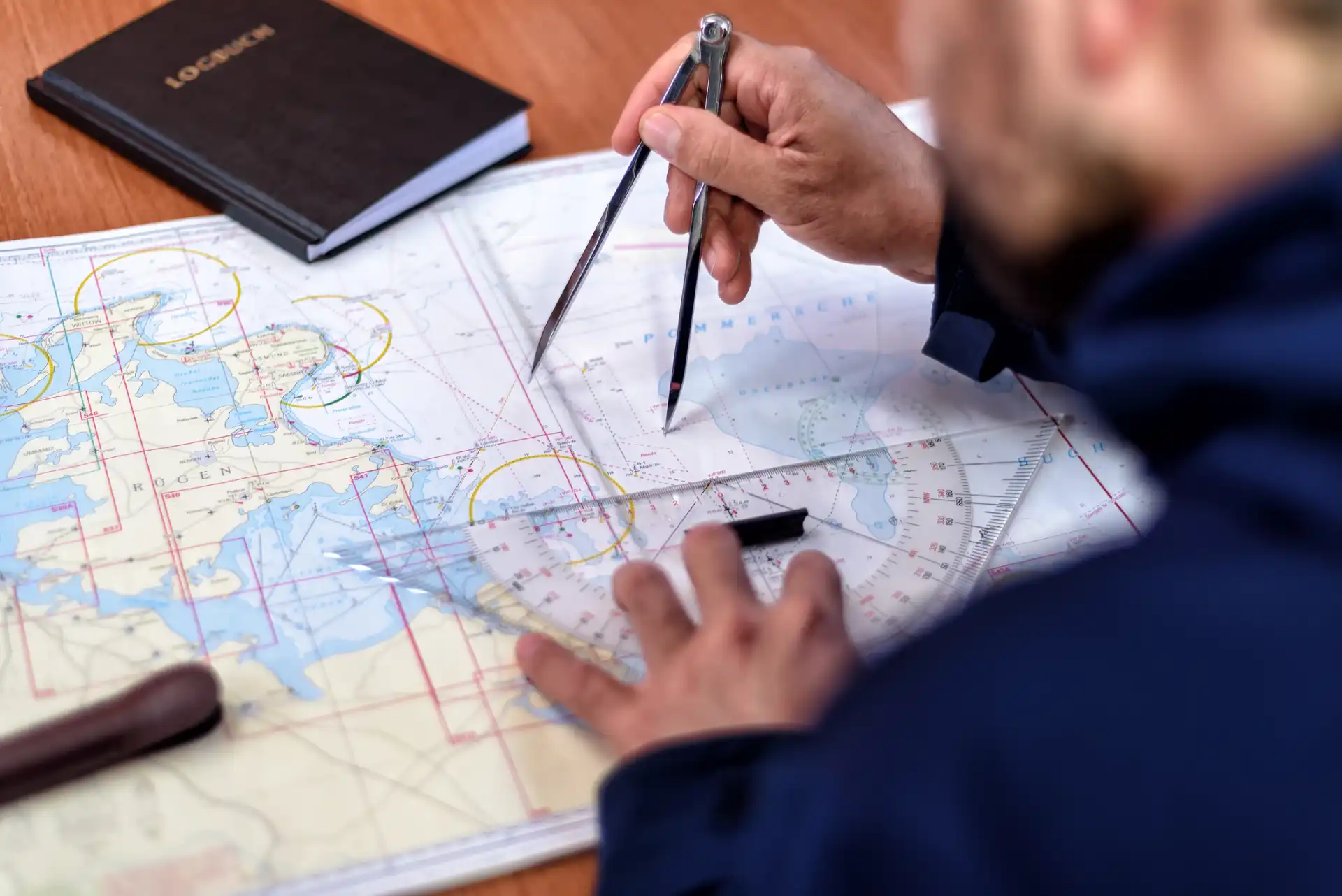
At Sailing Course Online, the course fee includes physical Admiralty training charts, a Portland plotter, dividers, and all exam papers, shipped free to your door anywhere in the world. Next-day delivery in the UK, express international shipping everywhere else.
Your exams are included, with unlimited retakes. You get 12 months to complete the course, and once you've passed, you keep lifetime access to the course materials for revision before a charter or practical course.
Some providers charge extra for plotters and dividers, or for international shipping. It's worth comparing what's included, not just the headline price.
We also offer a full 24 hours of free, unrestricted access to the complete course before you pay anything. No credit card required. That gives you a genuine chance to test the learning platform, try a few modules, and make sure it works for you.
Tips for Studying Your Day Skipper Theory Online
Having taught over 50,000 students from 115 countries, we've seen what works.
Set a regular routine. Two or three evenings a week, even just an hour at a time, is far more effective than trying to cram over a single weekend. The material needs time to settle, particularly for chartwork and tides where you're building practical skills, not just memorising facts.
Don't skip the exercises. The module quizzes and practice chartwork exist for a reason. They highlight gaps before you reach the exam, and they build the kind of fluency you'll need when you're plotting a course on a real chart at the nav station.
Use the instructor support early. If something isn't clicking after a second attempt, ask. A quick message to your instructor can save hours of frustration. That's what the support is there for.
Study in short, focused blocks. Research consistently shows that 25 to 30 minute study sessions with short breaks are more effective for retention than long marathons. This is especially true for subjects like tidal stream calculations, where concentration matters.
Think about the practical course. Everything you learn in the theory feeds directly into your time on the water. If you're planning a passage planning practical course or a summer charter, having solid theory behind you makes the experience vastly more enjoyable and productive.
What Happens After You Pass?
The Day Skipper certificate is the starting point for a clear pathway:
Day Skipper Practical: A five-day hands-on course at an RYA training centre, where you put your theory into practice aboard a yacht. Our practical school at Hamble Point Marina on the Solent runs these throughout the sailing season.
International Certificate of Competence (ICC): Available to UK residents after completing both theory and practical. The ICC is a legal requirement for bareboat charter in many European countries, including Croatia, Greece, and Turkey.
Bareboat Charter: With your Day Skipper and ICC, you can charter a yacht independently in most of the world's popular cruising grounds.
Going further: If your ambitions extend beyond coastal cruising, the RYA Coastal Skipper/Yachtmaster™ Theory course builds on everything you've learned, covering offshore passages, more advanced meteorology, and electronic navigation.
You might also want to add a VHF Marine Radio (SRC) qualification at some point. It's a legal requirement to operate a marine radio, and it's a practical skill you'll use every time you go afloat.
Which Format Should You Choose?
There's no universal answer. The right choice is the one that helps you start, stay engaged, and finish.
A classroom course might suit you if you prefer a structured routine with set dates, you enjoy learning in a group, and you like having an instructor physically present while you work through chartwork exercises. It's a good format if you know you'll struggle to motivate yourself at home.
An online course might be a better fit if you need flexibility around work, family, or travel. If you want to control your own pace, revisit topics as many times as you need, and study from wherever you happen to be, online gives you that freedom. With the right provider, the instructor support is just as good as, and sometimes better than, a classroom.
The qualifications are identical. Charter companies, the RYA, and employers don't distinguish between the two. What matters is that you learn the material thoroughly and feel confident applying it.
If you're leaning towards online and want to see what it's actually like before committing, try our course free for 24 hours. No credit card, no obligation. Just start learning and see if it works for you.