Sep 18, 2026
The RYA Day Skipper Theory Exam: What's in the Two Papers and How They Are Marked
Richard Beniston


Last updated: 18 September 2026
The RYA Day Skipper theory exam is two papers, each of 120 minutes when sat online, at the end of the shorebased course. The General Assessment covers seamanship, safety, the collision regulations, buoyage and weather. The Chartwork Assessment has you plotting positions, working out tidal heights and calculating a course to steer on the RYA training charts. Both are reviewed by an examiner for your overall grasp of the subject rather than against a percentage, and you may use the RYA Training Almanac, the training charts and your plotting instruments, but nothing else.
Most people who have worked through the course properly come through it without difficulty. The papers are there to check that you understand the principles well enough to be trusted with a boat and crew in daylight, not to catch you out. Where students do lose marks, it is nearly always in the chartwork, and nearly always for the same handful of reasons, which I cover below because I review these papers every week.
This guide sets out what each paper contains, how the review works, what you can have on the desk, what happens if a paper needs more work, and one worked example of the kind of question the chartwork paper asks.
About the Author
Richard Beniston is an RYA Yachtmaster™ Examiner for Sail and Power, and one of only 22 RYA Instructor Trainers worldwide. He has 23 years' experience in professional sailing instruction, including three RORC Fastnet campaigns as skipper, Atlantic crossings, and sail training on tall ships in the Baltic. He is Chief Instructor at Sailing Course Online, an RYA-approved online theory provider based at Hamble Point Marina, which delivers RYA Day Skipper and Coastal Skipper/Yachtmaster™ Offshore theory courses to students in over 115 countries.
Learn more about our instructors
What is the RYA Day Skipper theory exam?
The RYA Day Skipper theory exam is the assessment at the end of the RYA Day Skipper Shorebased course, which we deliver online from Hamble Point Marina. Complete it and you receive the RYA/MCA Day Skipper Shorebased Certificate, which is the theory foundation for the Day Skipper practical course and, in due course, for the International Certificate of Competence.
The Royal Yachting Association sets the syllabus and issues the exam papers to its recognised training centres. The RYA sets a minimum of 40 hours of structured learning for the course, plus exam time, and states that it can be taken in a classroom, online or by distance learning. The certificate is identical whichever route you take, and so are the papers.
The exam is not a licence. There is no legal requirement to hold it before you take a boat to sea in the UK. What it does is prove, to a charter company, an insurer, a practical instructor or an examiner later in your sailing, that you have the theoretical navigation and seamanship knowledge the RYA expects of someone taking charge of a yacht by day in familiar waters. If you want to know what that lets you do in practice, once the relevant practical training is complete, we have set out what the certificate lets you do separately.
The two papers: what each one tests
The two papers divide the syllabus between them. One tests what you know; the other tests whether you can apply it on a chart.
| General Assessment | Chartwork Assessment | |
|---|---|---|
| What it tests | Seamanship, safety, collision regulations, lights and shapes, buoyage, meteorology, passage-planning principles | Position fixing, estimated position, course to steer, tidal heights and streams, a short passage plan |
| Question style | Short answer and multiple choice | Worked calculations and plots on the training charts |
| Time allowed | 120 minutes online (90 in a classroom) | 120 minutes online (90 in a classroom) |
| What you use | RYA Training Almanac and RYA Training Charts 3 and 4 for reference | RYA Training Charts 3 and 4, RYA Training Almanac, plotter, dividers |
| Reviewed on | Understanding of principles across the syllabus | Method, accuracy and interpretation of each plot |
The General Assessment ranges across the whole shorebased syllabus except the plotting. Expect to identify a vessel from its lights, say who gives way in a crossing situation, name a cardinal mark from its topmark, describe what a falling barometer and backing wind mean for the next twelve hours, and explain what you would do if someone went over the side. The collision regulations carry a lot of weight here, so revise them last.
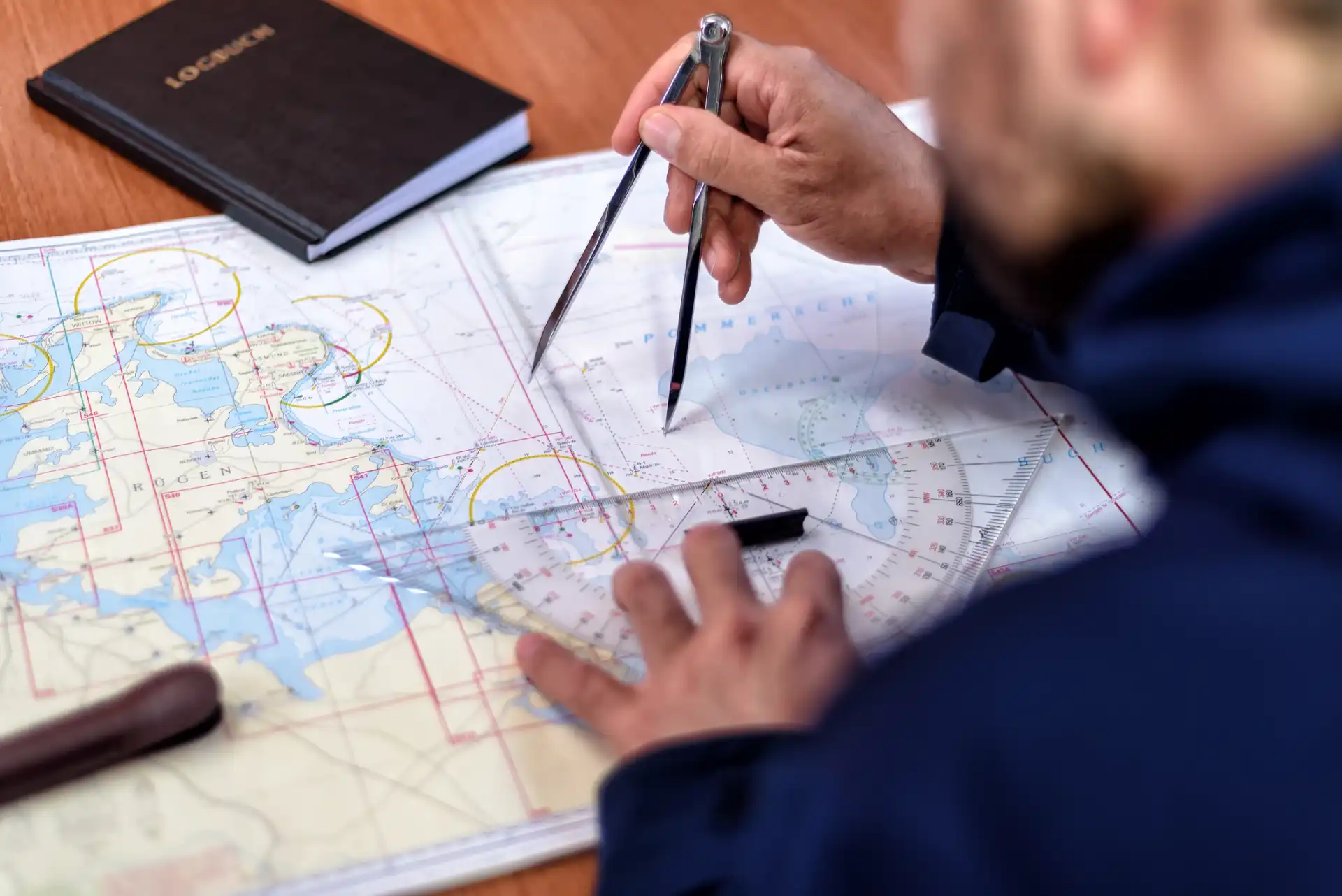
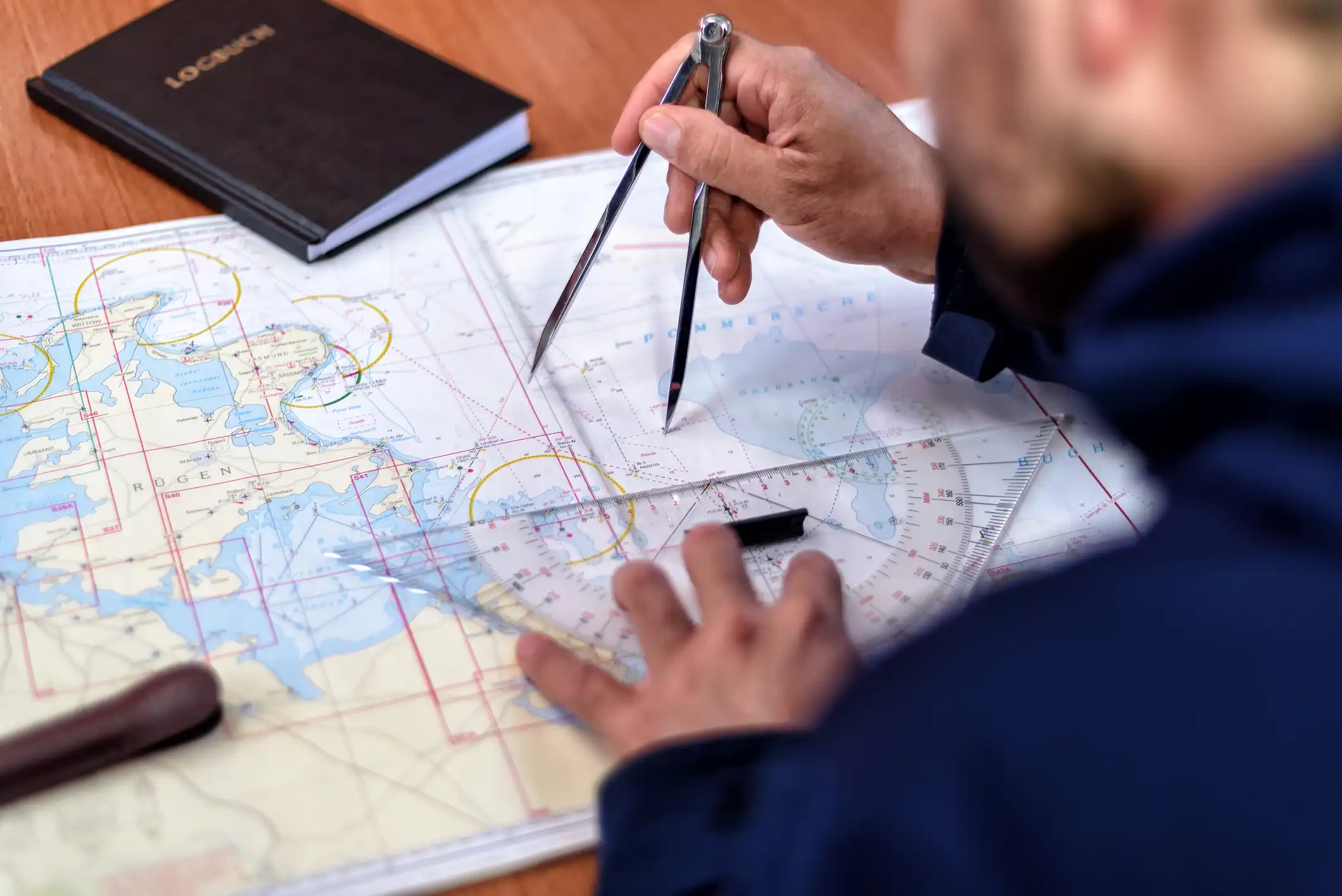
The Chartwork Assessment is the one people worry about. It uses RYA Training Charts 3 and 4, which cover a fictional stretch of coast, and the RYA Training Almanac, which contains tide tables and port information for that same fictional coast. You may be asked to fix a position from bearings, work up an estimated position from a log reading and a tidal stream, calculate the height of tide at a given time, and plan a course to steer that allows for tide and leeway. Some papers include a short passage plan that pulls several of those together.
One point on timing. The RYA paper allows 90 minutes when sat in a classroom. Our online papers allow 120 minutes each, because you are working on your own at home without an instructor in the room to answer a quick question.
How is the Day Skipper theory exam reviewed?
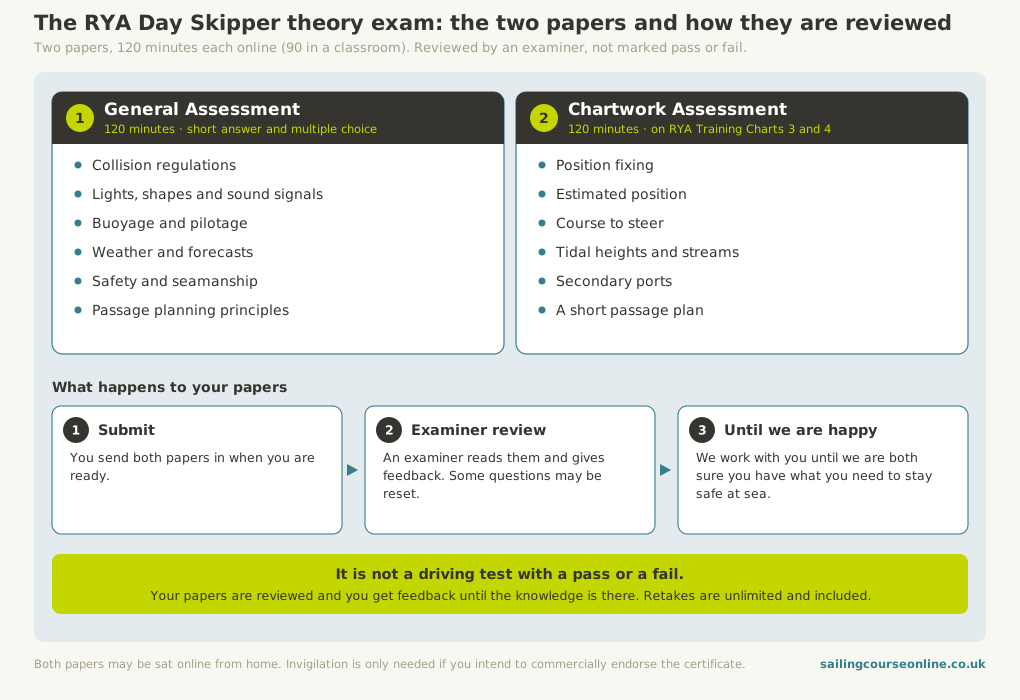
There is no percentage pass mark, and it is not like a driving test with a pass or a fail. You submit your papers and they are reviewed by a member of our instructor team. If they need more information from you, or need to reset a question, they give you feedback and you have another go at that part. We then work with you until we are mutually happy that you have everything you need to keep yourself and your crew as safe as possible while navigating at sea.
Behind that review sits the RYA's graded scheme, which runs from Excellent down to Poor. As published by RYA centres such as Cambridge University Yacht Club, it looks like this:
| Grade | What it means | What happens next |
|---|---|---|
| Excellent | No errors | Certificate issued |
| Very Good | One minor error (chartwork) or up to three (general paper) | Certificate issued |
| Good | One error in principle, or several minor errors | Certificate issued |
| Average | Two errors in principle, or more than one significant error, but general competence shown | Certificate issued |
| Fair | More than two errors in principle, showing confusion about the subject | Feedback and questions reset |
| Poor | Significant misunderstanding or lack of knowledge | Feedback, further study, questions reset |
The distinction that matters is between a minor error and an error in principle. A minor error is an arithmetic slip, a plotter held slightly off, a plotting symbol left out. An error in principle is using the wrong method: constructing a course to steer as if it were an estimated position, taking tidal data from the wrong day, forgetting to correct for daylight saving time, or applying variation in the wrong direction because you did not understand which way it goes. One of the first kind costs you almost nothing. Two or three of the second kind and the question comes back to you with feedback, however neat the drawing.
When a paper is reviewed here the student gets the grade and the feedback together, usually within 24 hours (Sailing Course Online, 2026). A reset question is a targeted exercise on the one thing that went wrong rather than a lottery.
What can you use in the exam?
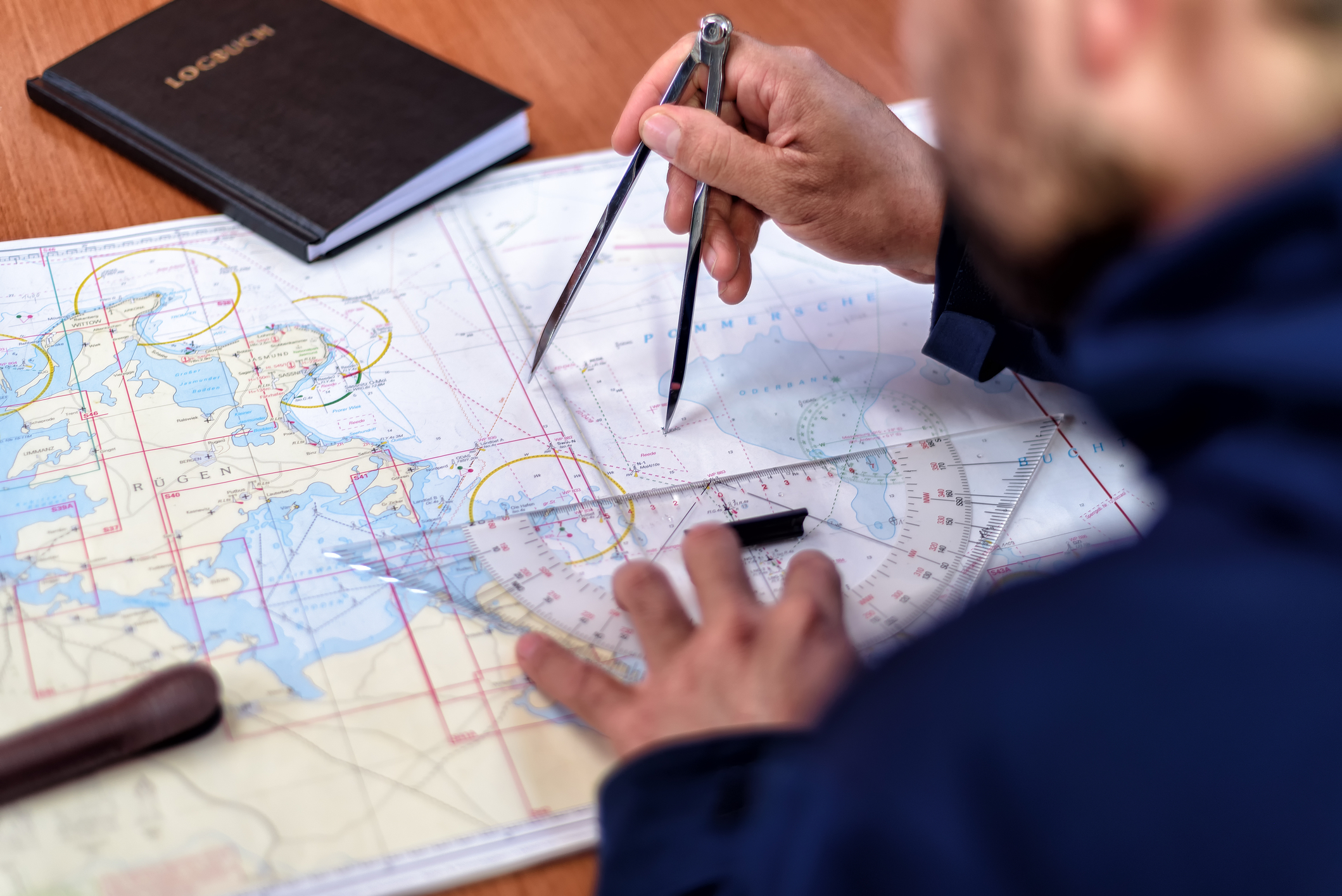
You may use the RYA Training Almanac, RYA Training Charts 3 and 4, a Portland plotter or equivalent, dividers, a pencil, a rubber and a calculator. You may not use your own notes, a real almanac or the internet.
The reason the almanac is a training almanac is worth understanding. The ports in it are fictional, so no app, website or real tide table can help you. Everything you need is in the book in front of you, and the paper is testing whether you can find it and use it. Students sometimes lose time hunting for a shortcut that does not exist.
For an online exam each paper is completed in one sitting, within the time limit. If you are asked to, the chartwork can be photographed or scanned and uploaded with your answers. A phone camera is fine. Allow a few minutes for that step and make sure the plot is legible before you send it.
Is Day Skipper theory hard?
The content is not difficult. The chartwork is detailed, and it punishes skipped steps.
Nothing on the syllabus is beyond anyone who can read a map and do simple arithmetic. What catches people is that a tidal height or a course to steer asks you to hold five or six steps in your head, in the right order, each one depending on the last. Get step two wrong and the answer is wrong however carefully you do steps three to six. One of our students put it well in a review this month: "Found the course quite challenging especially the chart work where you have to do many steps before coming to an answer but it's very rewarding" (Feefo, 9 September 2026).
The topics that take the most practice, in the order I see them cause worry, are tidal heights and secondary ports, then course to steer, then estimated position. The collision regulations are not hard to understand but there are a lot of them, and the general paper expects you to know them cold. A sailor on the r/sailing forum summed up the tone of the papers accurately: "At most they'll ask you to calculate a tide. They will ask you to identify buoy marks or lights. It will not be questions for the sake of" catching you out (Reddit, 2024).
Around 40 hours of study is the RYA's minimum, and most of our students finish within two to three months studying part-time (Sailing Course Online, 2026). If you have done the exercises as you went, rather than watched the videos and moved on, the exam holds few surprises.
Where people actually lose marks
Five errors account for most of the papers I review below Good. Each one is an error in principle, and each one is avoidable.
1. Tidal data from the wrong day or the wrong port. The almanac tide table has a column for every day of the month. Students read the line above or below, or take the standard port figures when the question asks for a secondary port. Put your finger on the date, say it out loud, and check the port name at the top of the page before you copy a single number.
2. Forgetting daylight saving time. The training almanac tables are in UT. If the question gives you a time in daylight saving time (BST in the UK), an hour has to come off before you enter the tables, and go back on before you write the answer. Miss it and every tidal height in the paper is an hour out.
3. Variation applied the wrong way. The course you plot on the chart is True. The course you give the helm is Magnetic. With westerly variation, magnetic is the bigger number. Learn one rule of thumb and use it every time; the students who get this wrong are usually the ones who try to reason it out fresh under time pressure.
4. Leeway left out of a course to steer. The paper tells you the wind direction and a leeway figure. Leeway is applied to the course, into the wind, after the tide has been allowed for. It is a small correction and it is the one most often forgotten because it comes last.
5. Building an estimated position when the question asks for a course to steer, or the other way round. They use the same three elements, but the triangle is constructed in a different order. An EP starts from where you were and asks where you are. A CTS starts from where you want to be and asks which way to point. Read the question twice and decide which triangle it is before you touch the plotter.
A worked example: one course to steer, start to finish
Here is a question of the shape the chartwork paper uses, with the method shown. The numbers are illustrative, so do not look for them on the training chart.
You are at a known position and want to reach a buoy that bears 090°T, 6 miles away. Your boat speed through the water is 5 knots. For the hour of the passage the tidal stream, which in a real paper you may have to find from the time and date, is setting 180°T at 1.5 knots. Variation is 3°W. The wind is from the north and you expect 5° of leeway. What is the compass course to steer?
Step 1. Draw the ground track. From your position, plot the line to the buoy at 090°T and carry it well beyond. This is where you want to go over the ground. Mark the line with two arrowheads.
Step 2. Plot one hour of tide from the start. From your position, draw the tidal vector: 180°T for 1.5 miles. Mark the line with three arrowheads. This is where the tide alone would carry you in an hour.
Step 3. Plot one hour of boat speed from the end of the tide vector to the ground track. Set the dividers to 5 miles. Put one point on the end of the tide vector and swing the other until it cuts the ground track. Draw that line and mark it with one arrowhead. Its direction is your water track.
Step 4. Read the water track. Measure it with the plotter. In this example it comes out at about 073°T. You are pointing the boat north of the buoy to counter a tide pushing you south.
Step 5. Apply leeway. The wind is from the north and will push the boat south, so you steer into it: subtract 5° to give 068°T.
Step 6. Convert to magnetic. Variation is 3°W, so add 3°: 071°M.
Step 7. Answer. Course to steer 071°M. Note also that the boat-speed vector cut the ground track short of the buoy, so the passage will take a little over an hour; the paper may ask for that too.
Every one of the five errors above could have happened inside those seven steps. Tide from the wrong hour at step 2, a tide vector plotted from the buoy instead of the start, leeway forgotten at step 5, variation subtracted at step 6. The method is not difficult. The discipline is in doing every step, in order, every time.
What happens if a paper needs more work?
A paper that falls short in one area is not the end of the exam. The instructor resets the questions on the specific area that let you down, and once you answer those correctly under exam conditions the paper is complete. The other paper stands.
If the gap is wider, you will be asked to go back over the relevant modules and complete practice questions before attempting the questions again. Retakes at Sailing Course Online are unlimited and included in the course fee, along with instructor support by message, phone or video call for as long as you need it (Sailing Course Online, 2026). Nobody is left to work it out alone; the job of the examiner is to get you to the standard.
Online exam or invigilated exam: which do you need?
For leisure sailing, chartering abroad and applying for the ICC, the exam sat online at home is all you need. That covers the overwhelming majority of Day Skipper students.
Invigilation matters in one situation: if you intend to commercially endorse the certificate to work for hire on small commercial vessels. The RYA states that for the professional route the theory exam must be invigilated at an RYA training centre, whichever way the course was delivered. If that is your plan, say so before you sit the papers, because an exam taken at home cannot be invigilated retrospectively. We explain the full process in our guide to how to commercially endorse the certificate.
How long does it take, and does the certificate expire?
The RYA's minimum is 40 hours of structured learning plus exam time. In practice most of our students spread that over two to three months around work, though some do it in a fortnight and some take most of the twelve months they are given.
The RYA Day Skipper Shorebased Certificate does not carry an expiry date. Once you have it, you have it. That said, the RYA revises the syllabus from time to time, most recently to put electronic charts and navigation apps at the centre of the course ahead of the UK Hydrographic Office's withdrawal of paper Admiralty charts after 2030 (UKHO), so a certificate earned some years ago does not mean your knowledge is current.
Once you hold it, the next shorebased step is the Coastal Skipper and Yachtmaster™ Offshore theory, which assumes everything in Day Skipper and pushes on into offshore passage planning and the full collision regulations. If you already know that is where you are heading, the two courses can be taken as one Fastrack programme.
You do not have to hold the theory certificate before booking the Day Skipper practical course. The practical week assumes the knowledge, though, and there is no time on board to teach tides and chartwork from scratch, so most people do the theory first, whether online or in a classroom.
How to prepare for the exam
Do every exercise as you go, on paper, with the chart. Watching a video on course to steer and nodding along is not the same as plotting one. Students who arrive at the exam having plotted twenty triangles do not lose marks on the twenty-first.
Sit the mock paper under time. Two hours is comfortable if you know the method and tight if you are working it out as you go. Timing yourself once tells you which you are. If you have not started yet and want to see what the exercises look like before committing, the free 24-hour trial gives you the full course, every module and quiz included, with no card required.
Keep the almanac open through the whole course, not just the tides module. The general paper expects you to find things in it quickly.
Revise the collision regulations last, immediately before the general paper. They are memory rather than method, and they fade fastest.
Then stop. A rested student who knows the method beats a tired one who has crammed.
Frequently asked questions
What is the pass mark for RYA Day Skipper theory?
There is no percentage pass mark. Each paper is graded from Excellent to Poor by an examiner, and a grade of Average or above earns the certificate. Average means the work shows general competence despite a couple of errors in principle. Below that, the questions concerned are reset with feedback and you have another go.
How long is the Day Skipper theory exam?
Two papers. Sat online with us, each paper allows 120 minutes; sat in a classroom, the RYA allows 90. Each paper must be completed in one sitting, and the online chartwork paper may need a few extra minutes at the end to photograph and upload your plot if you are asked to.
Can you fail Day Skipper theory?
Not in the way you fail a driving test. If a paper falls short, the questions concerned are reset, sometimes with fresh questions, and you are given feedback on where it went wrong. The other paper stands. Retakes are unlimited and included here, and we work with you until we are both happy you have the knowledge to stay safe at sea.
Can I get RYA Day Skipper theory exam papers or answers online?
No, and any site claiming to offer them is not offering the real thing. The papers are issued by the RYA to its centres and are not published. What you can and should do is work through the practice questions in the course and use the worked example above to check your method.
Do I need Day Skipper theory before the practical course?
Not as a formal requirement, but the practical course assumes you already understand tides, chartwork and the collision regulations, and there is no time to teach them on board. Doing the theory first is the sensible order and it is what most people do.
Does the RYA Day Skipper Shorebased Certificate expire?
No. It has no expiry date. The syllabus is revised periodically, so it is worth refreshing your knowledge before a charter if some years have passed.
Is the exam the same online and in a classroom?
Yes. The papers, the review process and the certificate are the same whichever way you study. Two things differ. Online papers allow 120 minutes each, where the classroom allowance is 90. And if you intend to commercially endorse the certificate, the exam must be invigilated at an RYA training centre.
The exam sits at the end of the RYA Day Skipper shorebased course. If you want to see how the course is structured before you commit, you can look through the modules it sits at the end of.